I chose Biodiversity of Pennsylvania as a project I wanted to contribute to. The loss of biodiversity has been a concern of the environmental movement for a considerable amount of time. Typically the oceans and tropical areas have been studied. These are ‘hot spots’ and are places of high concentrations of biodiversity. I agree they should be protected. Pennsylvania has had a substantial loss of biodiversity as well, especially since the arrival of the first Europeans (Kirkland et. al 1992). Plants have been studied in Pennsylvania for over 200 years and we have a record due to several historical collections. Biodiversity is often thought of as an indicator of an area’s environmental health. It can also be important for choosing an area to protect. An study can be undertaken to give weight to biodiversity indicators and also to ecological processes. This becomes important to consider which plot of land to save and how we can maximize our efforts and funds to best serve biodiversity conservation efforts (Eiswerth 2001).
The Biodiversity of Pennsylvania project is part of the umbrella project Biodiversity of the 50 states. The creator goes by the screen name, zoology123. He states that the reason for this project is he found it to be “outrageous that almost 43 of the 50 states didn’t have a biodiversity project.” on June 4, 2018 he created the project “Biodiversity of the United States, by State.” This project is for all 50 states and 16 territories in the United States. There are over 16 million observations by 475,000 people.
The Biodiversity of Pennsylvania Group has 33 members in it. A person just needs to register and be able to post photos or observations that have the location of Pennsylvania. There are no other qualifications based on education or standing.
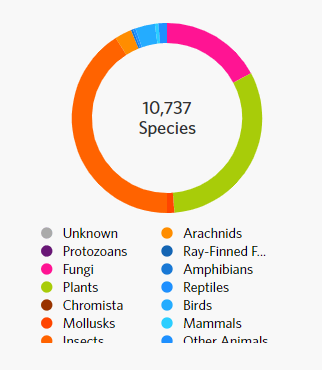
The Pennsylvania Diversity project has over 424, 000 observations of over 10,000 unique species. Of those species identified 41% were insects and 31.55 were plants. Mammals only made up . 58% of the total, leading me to surmise that that is an area that could use more postings of observations. If the data is to be used by organizations and conservation groups to help indicate which areas might be best conserved, we should have better documentation.
Eiswerth, M. E., & Haney, J. C. (2001, August 9). Maximizing conserved biodiversity: why ecosystem indicators and thresholds matter. Retrieved from https://www.sciencedirect.com/science/article/pii/S0921800901001665.
KIRKLAND, GORDON L., et al. “PERSPECTIVES ON BIODIVERSITY IN PENNSYLVANIA AND ITS MAINTENANCE.” Journal of the Pennsylvania Academy of Science, vol. 64, no. 3, 1990, pp. 155–159. JSTOR, http://www.jstor.org/stable/44148975.
 Citizen Science Project